

System-level stewardship in a changing formation landscape
Series: The Future of Formation (Part 4 of 4)
By Geoff Folland
April 2026
1. Opening position: Why I am writing this
Australia has not lost the need for trained Christian leaders. It has lost alignment in how those leaders are being formed.
Churches still need pastors. Church planting networks still need planters. Chaplaincy continues to expand. Mission agencies and parachurch organisations still need people who can handle Scripture with depth, lead with maturity, and engage missionally in an increasingly secular environment – forming disciples and initiating disciple-making movements across complex contexts. But fewer younger adults are entering the old formation pathway that once supplied much of that leadership stream. The demand remains. The old pattern of supply is weakening.
That is why this conversation matters.
I am not writing as a college principal, a denominational spokesperson, or a board chair. I am writing as someone who has spent three decades working across Australia’s mission ecosystem, and who has seen this sector from enough angles to recognise that the challenge is now larger than any one institution. I have sat in evening classes while working as an auditor. I have been shaped by preaching conferences and formal theological study. I have supervised interns, taught, assessed, and partnered with institutions across different traditions and delivery models.
That distance gives me no right to dictate solutions. But it does create a certain kind of freedom. I do not need to defend one balance sheet, one governing structure, or one inherited model. I can look at the whole field.
I am not neutral about the outcome. I care deeply about God’s mission to fulfil the Great Commission in Australia. And that mission is inseparable from the quality, depth, and fit of the leaders we are forming.
So my aim in this series is not to propose a winning institution or a single preferred model. It is to make the landscape easier to see. Because when a system has been built over decades, under different assumptions, with different theological traditions, funding structures, and institutional loyalties layered on top of one another, clarity itself becomes a form of service.
My hope is not to solve this from the outside. It is to help the right leaders see the same reality clearly enough that better decisions and more honest conversations become possible.
2. What the first three articles have established
The first three articles have argued that what we are seeing across the sector is not a series of isolated institutional difficulties. It is a system under pressure, responding in patterned and increasingly visible ways.
Article 1, “The Hidden Architecture” made the initial shift in perspective. The sector is not a loose collection of unrelated colleges. It is structured around a small number of operating systems – shared accreditation frameworks, self-accrediting institutions, distributed networks, and diversified providers – each with its own logic of delivery, governance, and formation. Once those systems are visible, the apparent complexity begins to resolve into something more coherent.
Article 2, “The Balance Sheet”, then reframed the conversation about survival at a more fundamental level. The decisive divide is not primarily theological. It is economic. Some institutions are sustained by capital: assets, reserves, and time. Others are sustained by flow: enrolments, fees, and partnerships that must hold year by year. That distinction shapes behaviour under pressure. It determines who can move slowly, who must move quickly, and how risk is absorbed across the system.
Article 3, “The Adaptation Question”, showed that adaptation is already well underway, but not in a uniform direction. Institutions are scaling, consolidating, distributing delivery, and diversifying into adjacent fields. At the same time, apprenticeship pathways, church-based formation, and mission agency pipelines are strengthening alongside formal theological education. The result is not convergence on a single new model, but fragmentation into multiple competing logics of formation – each solving a real problem and introducing new trade-offs.
Taken together, these shifts point to a more demanding conclusion. The old formation model was built for a different moment: a more stable church ecosystem, a more linear ministry pathway, and a lower regulatory burden. That world has changed. The cost base has risen. The student profile has shifted. The pathways into ministry have diversified.
The system is already changing. The question now is whether we understand that change well enough to respond coherently rather than reactively.
If that understanding remains partial, each institution will continue to adapt in isolation. And the overall system will become more complex at the very point where clarity and coordination are most needed.
3. The unresolved tension: Demand remains, attraction narrows
The presenting issue is not a collapse in demand. It is a misalignment between the kinds of leaders the mission requires and the pathways through which those leaders are now formed.
Across Australia, the need for trained leaders remains evident. Existing churches continue to require pastors, some with specialised skills. Church planting networks are setting explicit targets and building pipelines to meet them. Chaplaincy is expanding across schools, aged care, and community settings. Mission agencies, including campus and youth ministries, are recruiting early and investing heavily in leadership development. None of these signals point to contraction. They point to diversification.
What has changed is not the need, but the entry point.
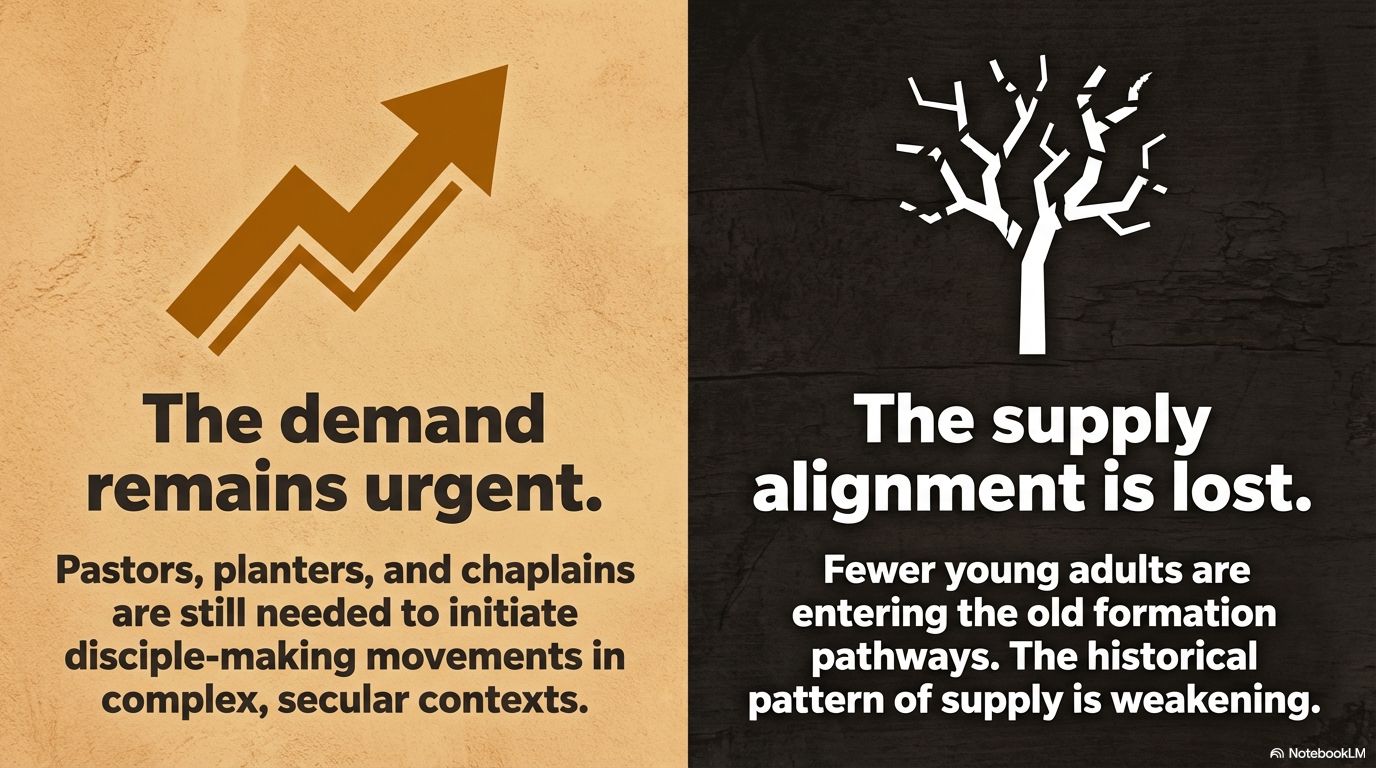
The traditional model – full-time, residential theological study as the primary gateway into ministry – no longer functions as the dominant pathway. It still exists and, in some contexts, remains highly effective. But it now sits alongside a widening range of alternatives: apprenticeships, church-based training, part-time and online study, and hybrid models where ministry experience and formal education are interwoven rather than sequential.
This is where the tension sharpens.
On one side, the system requires leaders who can handle Scripture with depth, think theologically, and operate as evangelists and disciplemakers in an increasingly secular and contested environment – leaders who can initiate and sustain disciplemaking movements, engage thoughtfully with culture, and lead missionally across diverse contexts such as campuses, cities, and global settings. On the other hand, fewer younger adults appear to be entering the older formation pipeline designed to produce that kind of leader at scale. The profile of the student has shifted… older, part-time, often already in ministry or employment, and frequently navigating study alongside other commitments.
In earlier articles, I used the shorthand of two archetypes. The “Gary” model represented the younger, full-time residential student preparing for vocational ministry. The “Susan” model captured the older, part-time student integrating study with existing responsibilities. That balance has shifted. The Gary pathway has narrowed. The Susan pathway now carries a greater share of the formal system.
That shift is not inherently negative. It reflects real changes in how people come to ministry, how they are trained, and how they sustain that training financially and vocationally. But it does create a structural tension.
We are asking a system designed around one dominant pathway to serve a much more varied and fragmented set of entry points.
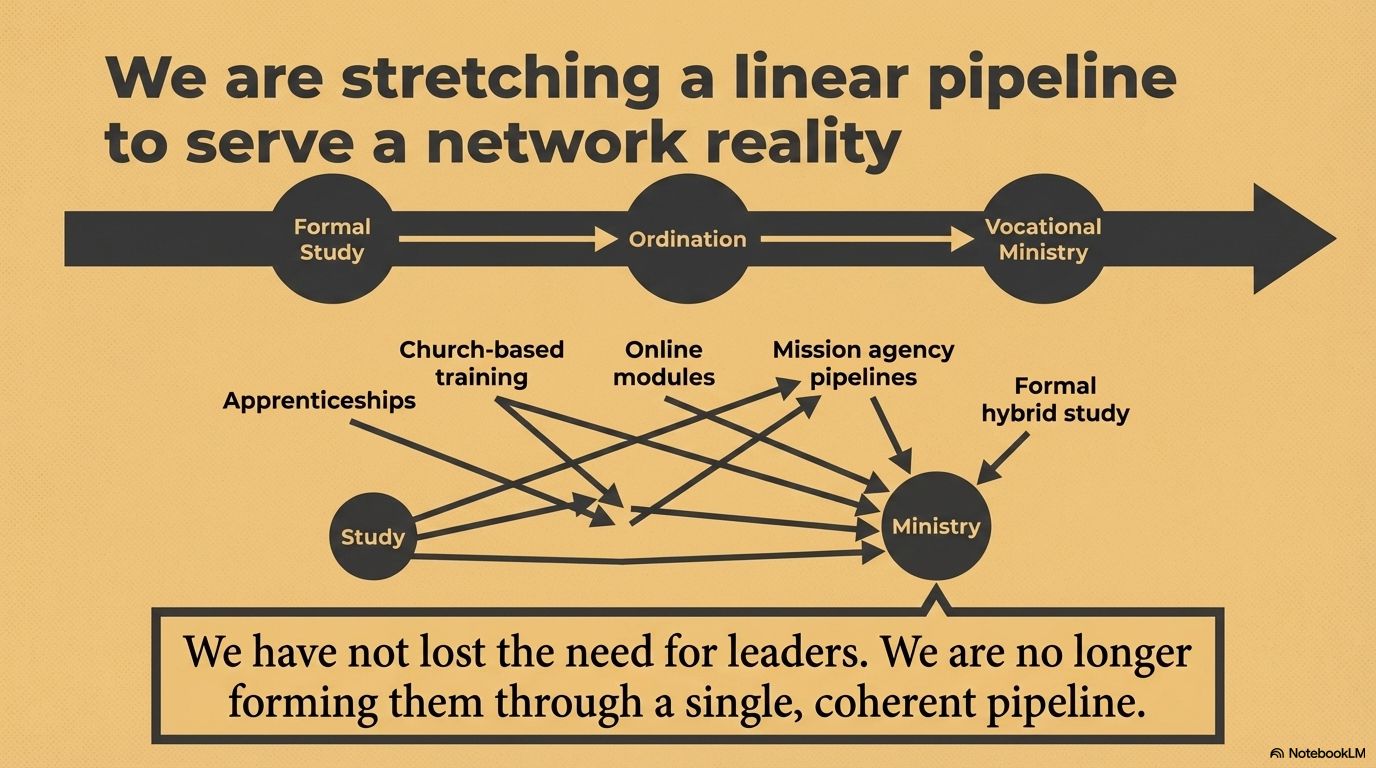
The result is a widening gap. Not necessarily between supply and demand in a simple numerical sense, but between the formation structures we have inherited and the formation patterns that are actually emerging.
We have not lost the need for leaders. We are no longer forming them through a single, coherent pipeline.
4. This is not a Bible college problem alone
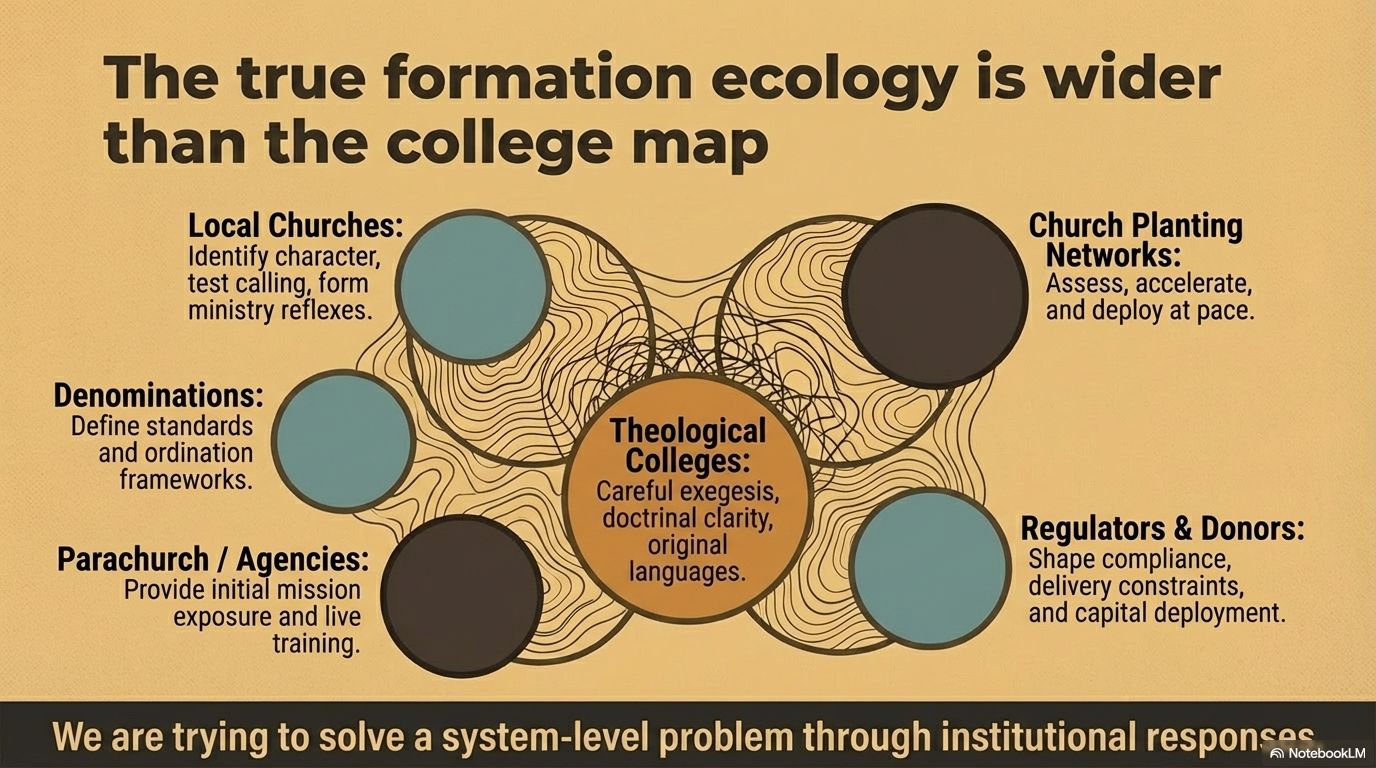
If the issue were confined to colleges, it could be addressed within colleges. It is not. The formation of leaders in Australia now sits within a wider ecology of institutions, networks, and pathways that no single actor controls.
Bible colleges and theological providers still carry a critical responsibility. They sustain the disciplines that are hardest to reproduce elsewhere: careful exegesis, doctrinal clarity, engagement with the original languages, and the formation of theological judgement over time. That work remains essential, particularly as ministry contexts become more complex and contested.
But colleges do not call people into ministry. Local churches do. They identify character, test conviction, and provide the first real context in which leadership is observed and formed. Increasingly, they also provide structured apprenticeships and ministry roles that shape leaders well before, or alongside, formal study.
Denominations continue to play a defining role through ordination pathways, standards, and the institutional frameworks that shape long-term supply. Their decisions determine not only who is recognised, but what kind of formation is required for recognition.
Church planting networks operate with a different time horizon and a different set of pressures. They are tasked with identifying, assessing, and deploying leaders into new contexts, often at pace. Their pipelines are structured, intentional, and increasingly influential in shaping what counts as readiness for ministry.
Alongside these, parachurch ministries – campus movements, youth organisations, mission agencies – intersect with potential leaders at an earlier stage. They expose people to mission, test calling in live environments, and often provide the first serious layer of ministry training. For many, this is where the trajectory toward vocational ministry begins to take shape.
Then there are the actors who sit further back but still exert real influence. Donors and foundations determine what capital is preserved, deployed, or redirected. Regulators and accrediting bodies shape the cost structures, compliance requirements, and delivery constraints within which colleges must operate.
When Article 1 mapped the system, it showed that even at the level of formal education, there is no single model – only a set of distinct operating systems. Article 3 extended that map by showing that apprenticeship and parallel formation sectors now operate alongside, and sometimes ahead of, formal theological pathways.
The implication is straightforward.
The real formation system is wider than the college map.
Yet much of the current conversation still treats this as if it were primarily a college problem – something to be solved through institutional strategy, program design, or internal reform. That framing is too narrow. It pushes responsibility down to one part of the system for an outcome that depends on the whole.
We are trying to solve a system-level problem through institutional responses. That is one reason the conversation keeps narrowing before it has properly begun.
5. The places where cooperation breaks down
If the system were purely technical, coordination would be difficult but manageable. In practice, the barriers are more deeply embedded. They are structural, cultural, and, at times, emotional.
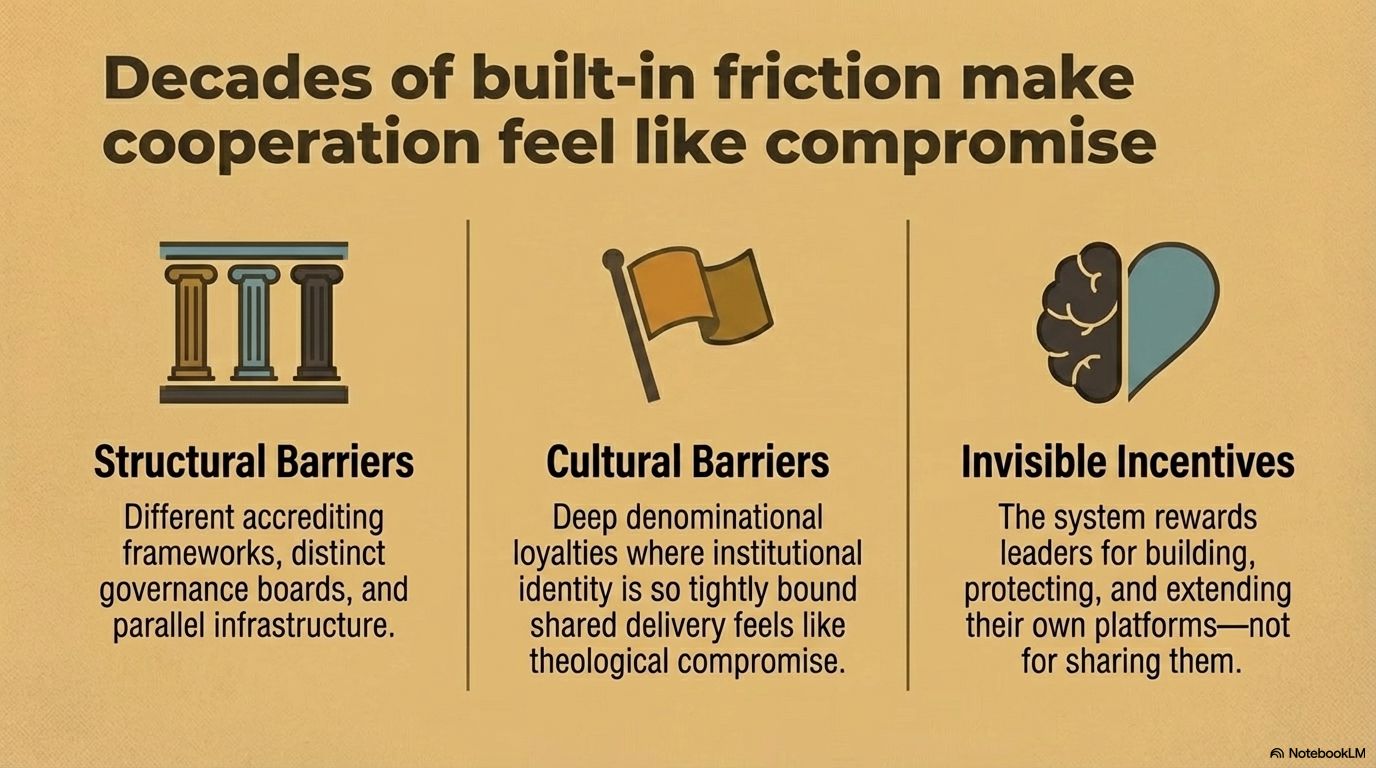
Some duplication is built into the system itself. Different accrediting frameworks, governance models, and ecclesial structures make alignment complex. Institutions answer to different boards, different standards, and different histories. Even when leaders are willing, the machinery of the system can slow or prevent cooperation.
But not all duplication is structural. Some of it is cultural.
Denominational loyalty carries weight, as it should. Institutions exist to serve particular theological convictions and ministry traditions. That clarity is not a weakness. It is often a strength. But it can also narrow the field of collaboration. When identity is closely tied to institutional form, cooperation can begin to feel like compromise rather than stewardship.
There is also another dynamic at work. Institutions, like all organisations, develop a sense of ownership over their mission, their people, and their pathways. The instinct to build, protect, and extend one’s own platform is not unusual. It is rewarded. But at the system level, it can lead to parallel efforts that overlap more than necessary.
The result is visible in places where infrastructure sits side by side, serving similar purposes with limited coordination. Article 1 pointed to the Burwood–Croydon corridor as a clear example, where multiple institutions operate within a few kilometres of each other, each carrying its own facilities, staffing structures, and delivery models.
Article 2 raised the more difficult question beneath that observation. When resources are finite and pressures are increasing, which distinctives genuinely require separate structures, and which are being preserved at a cost that is becoming harder to justify?
This is not primarily a question of good or bad intent. Most leaders in this space are acting in good faith, seeking to preserve what they believe matters for the sake of the gospel. The issue is that the incentives shaping behaviour have been set over a long period of time, under different conditions.
Those incentives do not automatically adjust when the environment changes.
So, cooperation does not break down because leaders are unwilling. It often breaks down because the system has trained them, over time, to operate independently, to protect their own mandates, and to measure success within institutional rather than shared categories.
In some places, we are duplicating what could be shared, while competing for what would be better developed together.
6. What current adaptations have revealed
It would be a mistake to describe the sector as static. It is not. Leaders across the system have responded with intelligence and resolve to pressures that are both real and persistent. The issue is not a lack of adaptation. It is what those adaptations are revealing.
Across the system, both institutions and formation networks have pursued different forms of adaptation, consolidation, and platform logic. Morling’s expansion and integration activities reflect an attempt to build a broader national presence, supported by a property strategy and denominational alignment. ACOM’s evolution, including its relationship with Stirling, points toward a more distributed model with adjacent vocational streams. Alphacrucis has extended further, combining scale, movement alignment, and multidisciplinary reach within a vertically integrated structure.
Alongside this, other institutions have taken a different path. Moore has reinforced depth – doctrinal clarity, faculty continuity, and long-horizon capacity supported by a substantial balance sheet. This is not resistance to change so much as a different judgment about what must be preserved in order for the system to remain theologically and intellectually credible over time.
Beyond the formal sector, the parallel formation system has continued to strengthen. Apprenticeship pathways, church-based training models, and mission agency pipelines are identifying and forming leaders in live ministry contexts, often before formal theological education is complete, and sometimes independently of it.
Each of these responses is rational. Each addresses a real constraint.
Scale spreads fixed costs and extends reach. Distributed delivery increases accessibility and aligns study with practice. Capital-backed models preserve depth and continuity. Apprenticeship pathways accelerate exposure to real ministry and allow earlier testing of calling.
But these responses are not solving the same problem. They are solving different problems, from different starting points, under different constraints.
That matters.
Because as the system adapts, it is not converging. It is becoming more varied. The logics of formation are diverging even as the need for alignment across the system is increasing.
What appears as innovation at the institutional level can, at the system level, compound fragmentation.
The net effect is that the sector has bought time. It has extended reach. It has opened new pathways into ministry.
But it has not, by itself, resolved the underlying question of how these different pathways relate to one another, or how they collectively form the leaders the next phase of mission will require.
The pressure has not disappeared. It has been redistributed.
7. A first-person observation about formation and timing
At this point, the discussion can easily become abstract—academic versus practical, institutional versus local, formal versus informal. My own experience does not fit neatly into those categories, and that is precisely the point.
I began with highly practical, ministry-facing training through Power to Change. It was immediate, immersive, and oriented toward evangelism and disciplemaking in a live environment. The feedback loops were fast. You saw quickly what worked, what didn’t, and where your own character and convictions were being tested.
That training was not shallow. But it was not comprehensive.
Over time, it became clear that there were gaps—particularly in handling Scripture with precision, engaging theological questions at depth, and understanding the broader intellectual and historical frameworks that shape Christian thought. Formal theological study came later, alongside ongoing ministry. It did something the earlier phase could not. It slowed the process down. It required sustained attention. It forced engagement with the original languages and with serious exegesis. That work has remained some of the most valuable formation I have received.
Interestingly, not every component translated equally. Some of the units labelled “practical” were less directly applicable to the realities of ministry than expected. The most enduring value came from the disciplines that trained the mind and sharpened judgment over time.
Taken together, these experiences do not point to a simple preference for one model over another. They point to a sequencing issue.
Practical ministry exposure and formal theological education are both necessary. But they do not always need to occur at the same stage, in the same format, or under the same institutional structure. When they are aligned well, they reinforce each other. When they are not, one can compensate for the other’s absence, but usually at some cost.
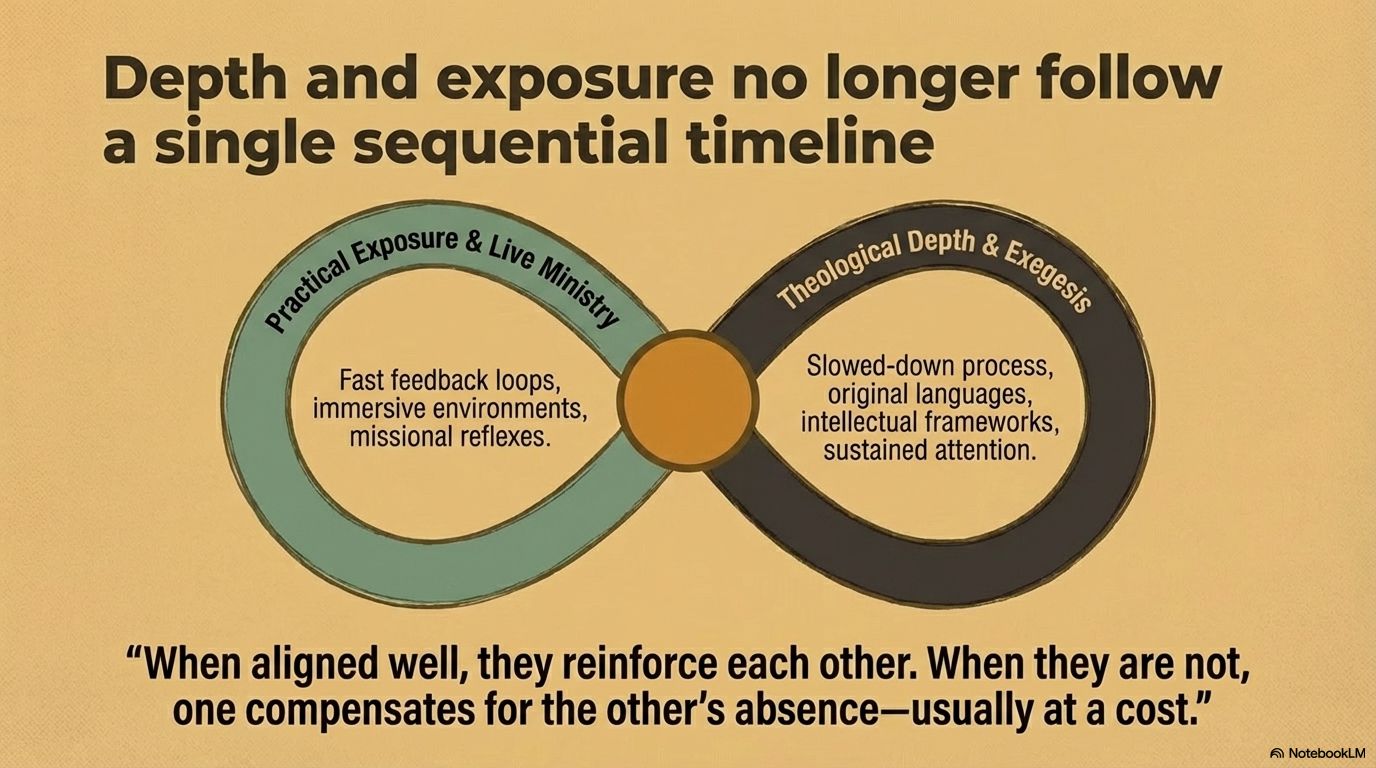
That has implications for how we think about formation pathways today. If the system assumes a single sequence – study followed by ministry – it will struggle to serve those whose formation is already occurring in different orders and in different places.
The question is not whether leaders need theological depth. They do. The question is how, when, and in what setting that depth is most effectively formed, particularly for leaders being raised in mission contexts where the demands are immediate and the environment is increasingly complex.
8. The decisions the sector can no longer avoid
If the problem were primarily about survival, the response would be tactical—cost control, program adjustment, incremental change. But the analysis to this point suggests something more fundamental. The issue is not whether the system can continue in some form. It is whether it will be stewarded well.
That shifts the nature of the decisions ahead.
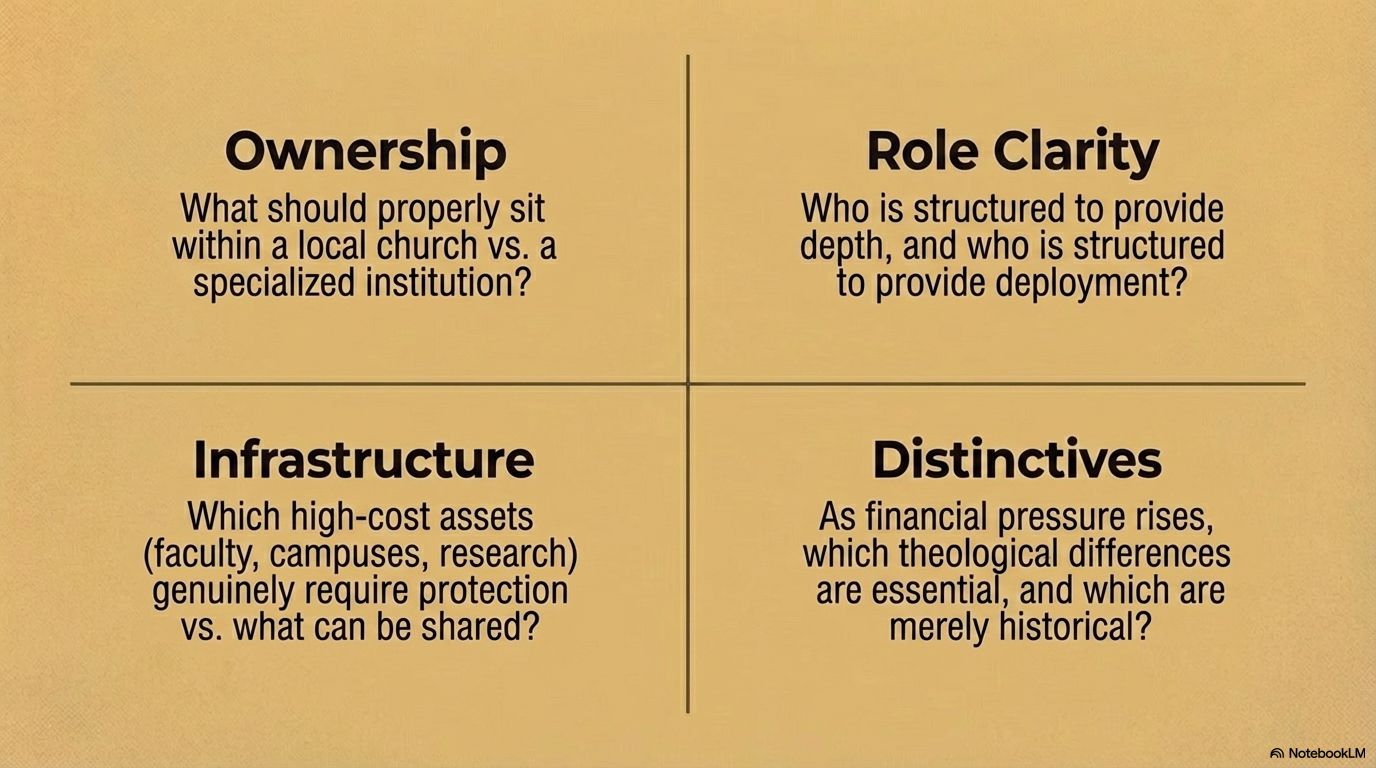
The first set of questions concerns ownership. What should properly sit within a local church, where calling is recognised, character is tested, and ministry reflexes are formed? And what should be shared or outsourced to institutions that can sustain specialised disciplines over time?
Closely related is the question of role clarity. What belongs to a theological college, and what belongs to an apprenticeship network or a mission agency? Colleges are structured to provide depth, coherence, and continuity in theological education. Apprenticeship pathways and mission organisations are structured to provide exposure, acceleration, and deployment. When those roles are blurred, effort is often duplicated, and outcomes become less clear.
There is also a question of infrastructure. Which parts of the system genuinely require high-cost, academically intensive environments: faculty, research capability, language instruction, and long-form theological reflection? And which parts can be delivered more flexibly, closer to where ministry is already taking place, without losing integrity?
Then there is the more difficult question of distinctives. Some theological, ecclesial, and methodological differences do warrant separate institutions. They shape doctrine, practice, and leadership in ways that cannot simply be merged. But not every distinction carries the same weight. As financial pressure increases, boards and leaders will be required to ask which differences are essential, and which are being maintained through structures that may no longer be sustainable.
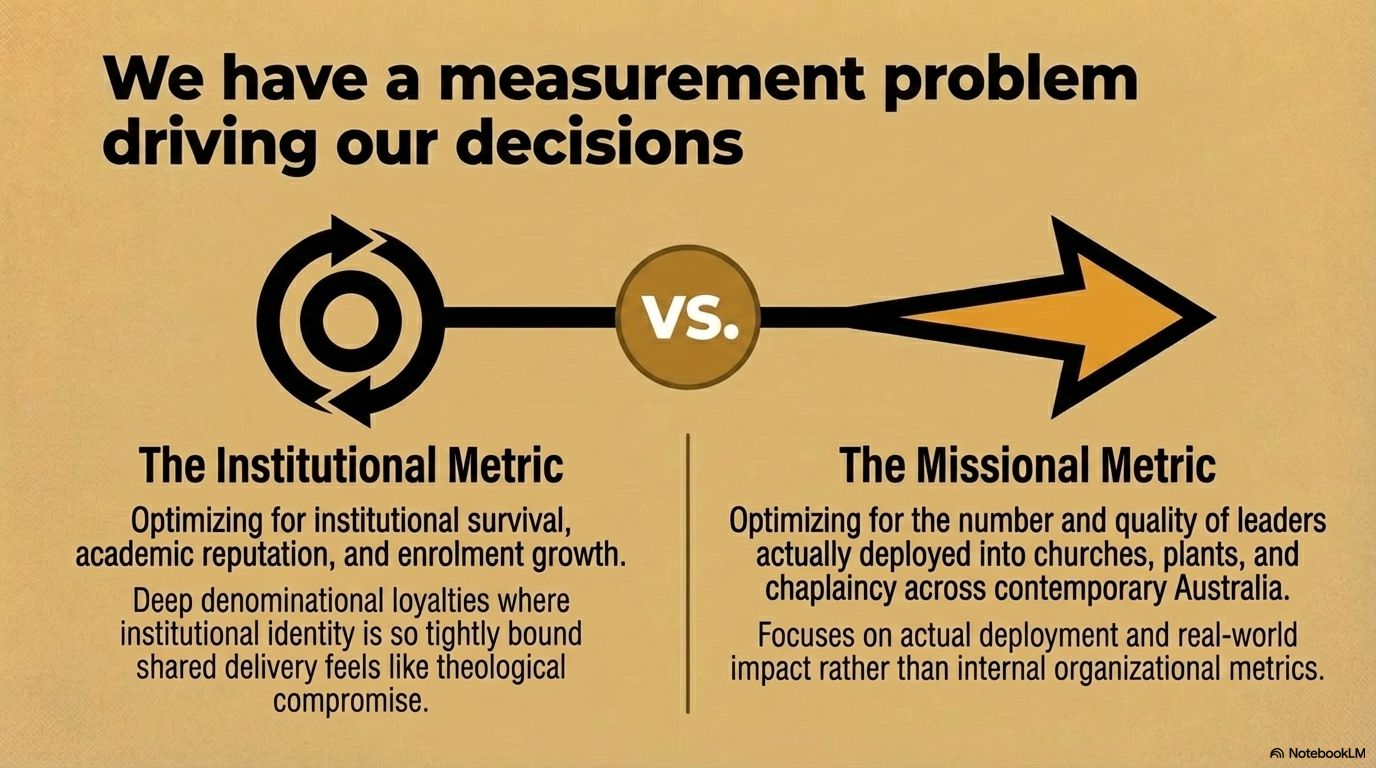
Underlying all of this is a measurement problem.
What, in the end, are we trying to optimise for? Institutional survival? Enrolment growth? Academic reputation? Or the number and quality of leaders who are actually deployed into churches, church plants, chaplaincy, and mission – leaders who can evangelise, make disciples, and lead in the real conditions of contemporary Australia?
Different answers to that question will produce different decisions.
None of these issues can be resolved by a single blueprint. The system is too diverse, and the constraints are too varied. But they can no longer be deferred. The current moment requires leaders to make explicit choices about what they will hold, what they will share, and what they are willing to release.
The next phase of this sector will not be shaped by better language or more compelling positioning. It will be shaped by the clarity and courage of those decisions.
9. What I hope happens next
At this point, it would be easy to look for a model to adopt or a structure to recommend. That is not my intent.
I am not arguing that one institution has the answer, or that one system should prevail. The diversity across the sector reflects real theological convictions, different ministry contexts, and distinct histories. That diversity will remain. In many cases, it should.
What needs to change is the level and quality of conversation across those lines.
The leaders who shape this system – denominational executives, college boards, church planting networks, and mission organisations – are not operating in separate worlds. They are participating in the same formation ecology, whether or not that is explicitly acknowledged. Decisions made in one part of the system are already affecting the others: who is trained, how they are formed, where they are deployed, and what kind of leadership is sustained over time.
At present, much of that interaction is indirect. It shows up in enrolment patterns, recruitment pipelines, partnership arrangements, and, at times, in subtle competition for the same people and resources. What is often missing is a more direct, shared recognition of the problem itself.
The issue is no longer whether the system needs to change. It already is changing, and at pace. The issue is whether that change will be coherent, or whether it will continue as a series of uncoordinated adaptations that increase complexity without improving alignment.
That is why this series has not aimed at a single solution. The first step is not agreement on a model. It is agreement on the reality we are facing.
If leaders across the system can see that reality more clearly – if they can recognise that they are stewards of a shared challenge rather than isolated institutions—then the conditions for better decisions begin to emerge.
Progress, in this context, is unlikely to start with a comprehensive plan. It is more likely to begin with a different kind of conversation: more honest about constraints, more explicit about trade-offs, and more willing to consider forms of cooperation that may not have been necessary in an earlier era.
It is unlikely to begin with a public forum or a sector-wide initiative. More likely, it will start with a discreet conversation among a small group of leaders – those with both the trust and the capacity to move the system forward.
But it cannot end there. If the challenge is shared, the responsibility will need to broaden. The wider leadership layer – boards, networks, and institutions – will ultimately need to engage the same questions with equal clarity.
That is what I hope happens next.
10. Final conclusion — bringing the series to an end
Across these four articles, the picture has become clearer.
The sector is not random. It is structured around a small number of operating systems. It is not primarily divided by theology, but by economics – by whether institutions are sustained by capital or by flow. It is not static, but actively adapting through scale, distribution, diversification, and parallel formation pathways.
And yet, for all that movement, the central tension remains.
The question is no longer abstract. What we choose to measure and optimise will determine what kind of leaders are actually formed.
Australia still requires a steady supply of leaders who can handle Scripture with depth, lead with maturity, and engage missionally in an increasingly secular environment. But the pathways that once produced those leaders at scale are narrowing, while new pathways are emerging without a shared framework to hold them together.
This is not a problem that can be solved by any one college, network, or denomination. It sits at the level of the system itself.
Which means the question is not simply whether individual institutions will survive or adapt. It is whether the system, as a whole, will be stewarded with sufficient clarity and cooperation to meet the demands of the next generation of mission.
That requires a shift in perspective.
From institution to ecology.
From independence to interdependence.
From optimisation within silos to stewardship across the whole.
Some distinctives will remain. They should. Theology matters. Conviction matters. But not every structure that has grown up around those convictions will prove necessary or sustainable in the next phase.
The risk is not only decline. It is fragmentation: multiple strong parts, loosely connected, each solving its own problem while the system as a whole becomes harder to navigate, more expensive to sustain, and less aligned to the actual needs of the mission field.
The opportunity is different.
There is still significant intellectual capital, financial resources, and ministry experience embedded across this sector. There are capable leaders making thoughtful decisions under pressure. There are emerging pathways that are closer to the realities of contemporary ministry than those of a previous generation.
If those assets can be seen as shared rather than held in isolation, then the system has the potential not only to endure but also to become more responsive, more integrated, and more effective in forming the leaders required for the future. That will not happen by default. It will depend on whether those who carry responsibility for different parts of the system are willing to recognise that responsibility as shared stewardship. That is the horizon. Not a single model to implement, but a landscape to steward—together.
Geoff Folland
National Director
Power to Change